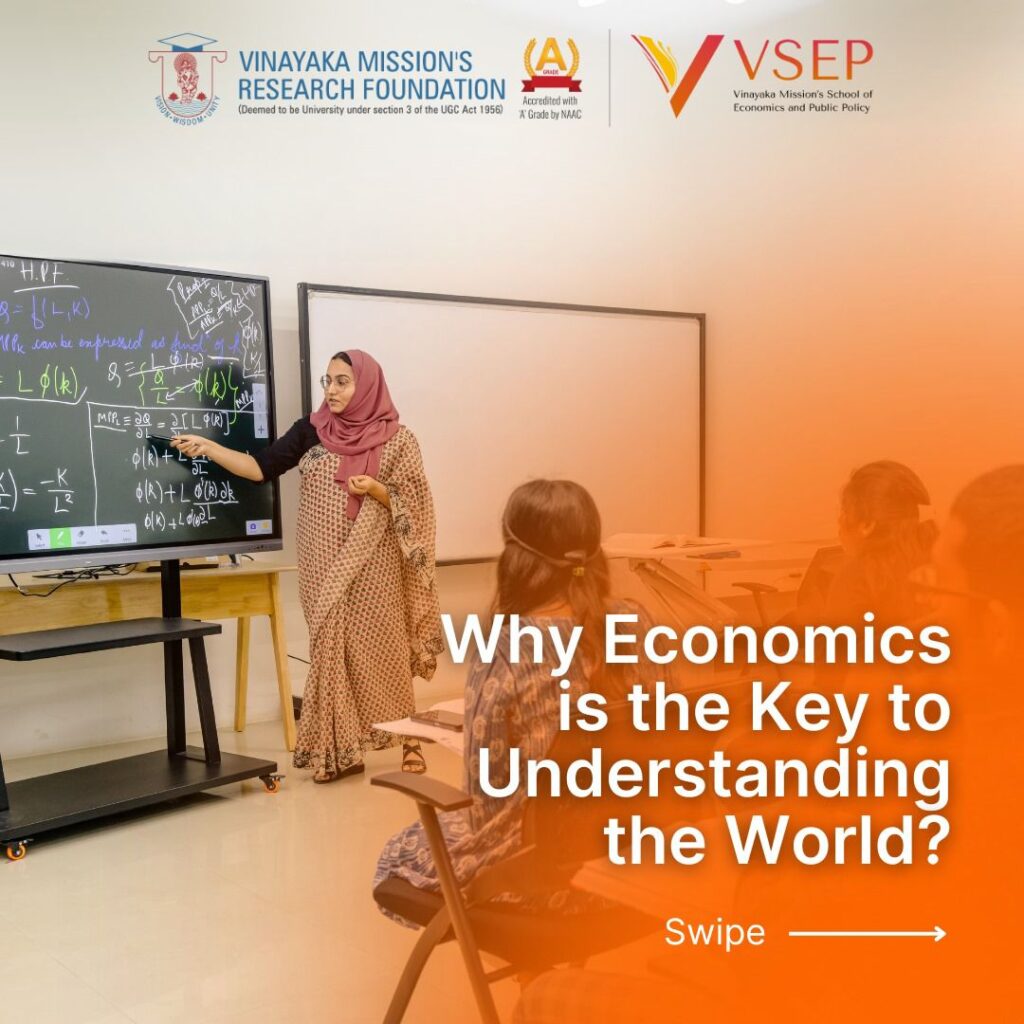
Choosing to pursue a BSc in Economics is an excellent decision for students who are passionate about understanding economic principles, financial systems, and global markets. Economics is a dynamic and challenging field that offers numerous career opportunities in various sectors, including finance, government, and consulting.
The BSc Economics syllabus is designed to provide students with a solid foundation in economic theories and real-world applications. This blog will give you an in-depth overview of the BSc Economics syllabus, highlighting the essential subjects, learning outcomes, and key concepts covered in the course. As one of the top BSc Economics colleges in India, Vinayaka Mission’s School of Economics and Public Policy (VSEP) offers a comprehensive curriculum that prepares students for a successful career in economics.
The Structure of the BSc Economics Syllabus
A typical BSc Economics syllabus is structured to offer a blend of theoretical knowledge and practical skills. Students will study a variety of subjects ranging from core economics topics to specialized areas like public policy, data analysis, and international economics. Here’s an overview of the main subjects covered throughout the program:
1. Microeconomics
Microeconomics is one of the core areas of economics, focusing on the behavior of individual consumers and firms. This subject provides insights into how markets function, the determination of prices, and the allocation of resources. Topics covered include demand and supply analysis, market structures (perfect competition, monopoly, oligopoly), and consumer behavior.
2. Macroeconomics
Macroeconomics deals with the study of the overall economy. It covers the larger economic factors that influence national and global economies, such as inflation, unemployment, economic growth, and government policies. Key topics in macroeconomics include national income, GDP, fiscal and monetary policy, and international trade.
3. Econometrics
Econometrics is the application of statistical and mathematical methods to economic data. It helps in analyzing economic trends and testing economic theories. In this subject, students learn how to use data to make predictions about economic outcomes, such as forecasting inflation or assessing the impact of government policies.
4. Mathematics for Economics
A solid understanding of mathematics is essential for any economics student. The Mathematics for Economics course covers topics such as calculus, linear algebra, and optimization techniques. These mathematical tools are used to model economic behavior, solve problems, and analyze real-world economic issues.
5. Statistics for Economics
Statistics plays a crucial role in economic analysis. In this subject, students learn how to collect, organize, and interpret data to make informed decisions. Topics include probability theory, hypothesis testing, regression analysis, and data visualization techniques. A strong grasp of statistics is essential for students pursuing careers in data analytics and research.
6. International Economics
International Economics is an important subject that examines the economic interactions between countries. Topics covered include international trade theory, exchange rates, global financial systems, and trade policies. This subject helps students understand how countries engage in trade and the effects of globalization on local and international economies.
7. Development Economics
Development Economics focuses on understanding the challenges faced by developing countries and the policies that can foster economic development. Topics include poverty, inequality, sustainable development, and the role of international organizations in promoting development. This subject is particularly relevant for students interested in working in government, NGOs, or international organizations.
8. Public Economics
Public Economics examines the role of government in the economy. Students learn about public goods, taxation, government spending, and public policy. The subject focuses on understanding how government policies affect economic outcomes and how public resources can be efficiently allocated to maximize social welfare.
9. Environmental Economics
Environmental Economics is a specialized field that focuses on the relationship between the economy and the environment. This subject explores topics such as environmental degradation, natural resource management, and sustainable development. Students learn about the economic impacts of environmental policies and the importance of balancing economic growth with environmental sustainability.
10. Indian Economy
The Indian Economy subject focuses on the economic structure, policies, and challenges faced by India. Students learn about India’s economic history, industrialization, agriculture, trade, and the role of government in shaping the economy. This subject provides students with a deep understanding of the unique economic conditions in India.
Key Learning Outcomes of the BSc Economics Syllabus
The BSc Economics syllabus is designed to equip students with several critical skills and knowledge that are essential for their career success. Here are some of the key learning outcomes:
Analytical Thinking: Students develop the ability to analyze complex economic problems using quantitative and qualitative methods.
Data Analysis: The course emphasizes the importance of data analysis, preparing students to make data-driven decisions in real-world economic scenarios.
Economic Theory: Students gain a strong understanding of both microeconomic and macroeconomic principles, which are crucial for understanding how economies function.
Policy Analysis: Students learn to evaluate government policies and their economic implications, which is crucial for those interested in working in public policy or research.
Problem-Solving Skills: The BSc Economics syllabus fosters critical thinking and problem-solving skills, enabling students to address real-world economic challenges.
How the BSc Economics Syllabus Prepares You for a Successful Career
A degree in BSc Economics is highly versatile, and the skills you acquire during your studies can be applied in various fields. The comprehensive syllabus at top BSc Economics colleges in India, such as Vinayaka Mission’s School of Economics and Public Policy (VSEP), ensures that students are well-prepared for careers in sectors like finance, government, consulting, and research.
Finance and Banking: With a solid foundation in economics and quantitative analysis, BSc Economics graduates can pursue careers in banking, financial analysis, and investment.
Public Policy: Students with an interest in governance and public policy can work in government agencies, think tanks, or international organizations.
Data Analytics: The emphasis on econometrics, statistics, and data analysis makes this program ideal for students pursuing careers in data science and analytics.
Consulting: Economics graduates are in high demand in consulting firms, where they apply their problem-solving and analytical skills to solve business challenges.
Conclusion
The BSc Economics syllabus provides a well-rounded education in economic theory, statistical methods, and real-world applications, preparing students for a wide range of career opportunities. Vinayaka Mission’s School of Economics and Public Policy (VSEP), as one of the top BSc Economics colleges in India, offers a comprehensive curriculum that prepares students for success in the dynamic world of economics. By choosing a program that combines academic rigor with practical learning, students can embark on a rewarding career in economics and contribute to solving some of the world’s most pressing economic challenges.